Search
Login Form
ADA 2010 Standards
- ADA 2010 Standards
- ADA Compliance standards
- 102 Dimensions Adults Children
- 103 Equivalent Facilitation
- 104 Convensions
- 105 Referenced Standards
- 201 Application
- 202 Existing Buildings and Facilities
- 203 General Exceptions
- 203 Employee Work Areas
- 204 Protruding Objects
- 205 Operable Parts
- 206 Accessible Routes
- 207 Accessible Means of Egress
- 208 Parking Spaces
- 209 Loading Zones & Bus Stops
- 210 Stairways
- 211 Drinking Fountains
- 212 Kitchens Lavatories Sinks
- 213 Toilet & Bathing
- 214 Washing Drying Machines
- 215 Fire Alarm Systems
- 216 Signs
- 217 Telephones
- 218 Transportation Facilities
- 219 Assistive Listening Systems
- 220 Automatic Tellers
- 221 Assembly Areas
- 222 Dressing Fitting Locker Room
- 223 Medical Care Long Term Facilities
- 224 Transient Lodging Guess Room
- 225 Storage
- 226 Dining & Work Surfaces
- 227 Sales & Servcie
- 228 Dispensers Machines Mail Fuel
- 229 Windows
- 230 Two Way Com Systems
- 231 Judicial Facilities & Courtrooms
- 232 Detention & Correctional Facilities
- 233 Residential Facilities
- 234 Amusement Rides
- 235 Boating Facilities
- 236 Exercise Machines
- 237 Fishing Piers & Platforms
- 238 Golf Facilities
- 239 Miniature Golf Facilities
- 240 Play Areas
- 241 Sauna & Steam Room
- 242 Swimming Pools Spas
- 243 Shooting Facilities
- 301 General
- 302 Floor & Ground Surfaces
- 303 Change in Level
- 304 Turning Spaces
- 305 Clear Floor & Ground Spaces
- 306 Knee and Toe Clearance
- 307 Protruding Objets
- 308 Reach Ranges
- 309 Operable Parts
- 401 General
- 401 New Construction
- 36.402 Alterations
- 403 Walking Surfaces
- 36.403 Alteration: Path of Travel
- 404 Doors Doorways & Gates
- 36.404 Alteration: Elevator Exemption
- 405 Ramps
- 36.405 Alteration: Historic Preservation
- 406 Curb Ramp
- 36.406 Standard New & Existing
- 407 Elevators
- 408 Limited Use Elevators
- 409 Residence Elevators
- 410 Platform Lift
- 501 General
- 502 Parking Spaces
- 503 Passenger Loading Zone
- 504 Stairways
- 505 Handrails
- 601 General
- 602 Drinking Fountains
- 603 Toilets & Bathrooms Room
- 604 Water Closets & Toilets
- 605 Urinals
- 606 Lavatories and Sinks
- 607 Bathtubs
- 608 Shower Compartments
- 609 Grab Bars
- 610 Seats
- 611 Washing Drying Machines
- 612 Sauna & Steam Room
- 701 General
- 702 Fire Alarm Systems
- 703 Signs
- 704 Telephones
- 705 Detectable Warnings
- 706 Assistive Listening Systems
- 707 Teller & Fare Machines
- 708 Two Way Com Systems
- 801 General
- 802 WheelShare & Companion Spaces
- 802 Design Aisle Seats
- 803 Dressing Fitting Locker Room
- 804 Kitchens & Kitchenettes
- 805 Medical & Long-Term Care
- 806 Transient Lodging Guest Rooms
- 807 Holding & Housing Cells
- 808 Courtrooms
- 809 Residential Dwelling Units
- 810 Transportation Facilities
- 811 Storage
- 901 General
- 902 Dinning & Work Surface
- 903 Benches
- 904 Check Out & Service Counters
- 1001 General
- 1002 Amusement Rides
- 1003 Recreation Boat Facilities
- 1004 Exercise Machines
- 1005 Fishing Piers & Platforms
- 1006 Golf Facilities
- 1007 Miniature Golf Facilities
- 1008 Play Access
- 1009 Swimming Pools Spas
- 1010 Shooting Facilities
ADA 1990 Standards
- ADA 1990 Standards
- ADA Purpose
- ADA Introduction & Definition
- Accessible Elements & Space
- Minimum Requirements
- Space Allowance & Reach
- Accessible Route
- Protruding Objects
- Ground & Floor Surfaces
- Curb Ramp
- Parking
- ADA Ramp
- Stairs
- Elevators
- Platform Lifts
- Windows
- Doors
- Entrances
- Drinking Fountains Water Coolers
- Water Closets
- Toilet Stalls
- Urinals
- Lavatories Mirrorsada-lavatories-mirrors
- Bathtubs
Business Guideline
- Small Business Guideline
- Introduction
- Existing Facilities
- Architectural Barriers
- Priorities for Barrier Removal
- Accessible Parking
- Accessible Entrance
- Doors at Entrances to Businesses
- Turnstiles/Security Gates at Entrances
- Shelves and Maneuvering Space
- Sales and Service Counters
- Serving Counters
- Fixed Seating and Tables
- Policies and Procedures
- Communicating with Customers
- Tax Credits and Deductions
- New Construction and Alterations
- New construction alterations 2010
- Helpfull Articles
- Checklist for Existing Facilities
- Restriping Parking Lots
- ADA Investigating Agency
- Toilet Layouts
Support ADA Compliance Directory Click HERE.
28 CFR 35.151 New construction and alterations
- (a) Design and construction.
- (1) Each facility or part of a facility constructed by, on behalf of, or for the use of a public entity shall be designed and constructed in such manner that the facility or part of the facility is readily accessible to and usable by individuals with disabilities, if the construction was commenced after January 26, 1992.
- (2) Exception for structural impracticability.
- (i) Full compliance with the requirements of this section is not required where a public entity can demonstrate that it is structurally impracticable to meet the requirements. Full compliance will be considered structurally impracticable only in those rare circumstances when the unique characteristics of terrain prevent the incorporation of accessibility features.
- (ii) If full compliance with this section would be structurally impracticable, compliance with this section is required to the extent that it is not structurally impracticable. In that case, any portion of the facility that can be made accessible shall be made accessible to the extent that it is not structurally impracticable.
- (iii) If providing accessibility in conformance with this section to individuals with certain disabilities (e.g., those who use wheelchairs) would be structurally impracticable, accessibility shall nonetheless be ensured to persons with other types of disabilities, (e.g., those who use crutches or who have sight, hearing, or mental impairments) in accordance with this section.
- (b)
Alterations
.- (1) Each facility or part of a facility altered by, on behalf of, or for the use of a public entity in a manner that affects or could affect the usability of the facility or part of the facility shall, to the maximum extent feasible, be altered in such manner that the altered portion of the facility is readily accessible to and usable by individuals with disabilities, if the alteration was commenced after January 26, 1992.
- (2) The path of travel requirements of § 35.151(b)(4) shall apply only to alterations undertaken solely for purposes other than to meet the program accessibility requirements of § 35.150.
- (3)
- (i) Alterations to historic properties shall comply, to the maximum extent feasible, with the provisions applicable to historic properties in the design standards specified in § 35.151(c).
- (ii) If it is not feasible to provide physical access to an historic property in a manner that will not threaten or destroy the historic significance of the building or facility, alternative methods of access shall be provided pursuant to the requirements of § 35.150.
- (4) Path of travel.An alteration that affects or could affect the usability of or access to an area of a facility that contains a primary function shall be made so as to ensure that, to the maximum extent feasible, the path of travel to the altered area and the restrooms, telephones, and drinking fountains serving the altered area are readily accessible to and usable by individuals with disabilities, including individuals who use wheelchairs, unless the cost and scope of such alterations is disproportionate to the cost of the overall alteration.
- (i) Primary function.A "primary function" is a major activity for which the facility is intended. Areas that contain a primary function include, but are not limited to, the dining area of a cafeteria, the meeting rooms in a conference center, as well as offices and other work areas in which the activities of the public entity using the facility are carried out.
- (A) Mechanical rooms, boiler rooms, supply storage rooms, employee lounges or locker rooms, janitorial closets, entrances, and corridors are not areas containing a primary function. Restrooms are not areas containing a primary function unless the provision of restrooms is a primary purpose of the area, e.g., in highway rest stops.
- (B) For the purposes of this section, alterations to windows, hardware, controls, electrical outlets, and signage shall not be deemed to be alterations that affect the usability of or access to an area containing a primary function.
- (ii) A "path of travel" includes a continuous, unobstructed way of pedestrian passage by means of which the altered area may be approached, entered, and exited, and which connects the altered area with an exterior approach (including sidewalks, streets, and parking areas), an entrance to the facility, and other parts of the facility.
- (A) An accessible path of travel may consist of walks and sidewalks, curb ramps and other interior or exterior pedestrian ramps; clear floor paths through lobbies, corridors, rooms, and other improved areas; parking access aisles; elevators and lifts; or a combination of these elements.
- (B) For the purposes of this section, the term "path of travel" also includes the restrooms, telephones, and drinking fountains serving the altered area.
- (C) Safe harbor. If a public entity has constructed or altered required elements of a path of travel in accordance with the specifications in either the 1991 Standards or the Uniform Federal Accessibility Standards before March 15, 2012, the public entity is not required to retrofit such elements to reflect incremental changes in the 2010 Standards solely because of an alteration to a primary function area served by that path of travel.
- (iii) Disproportionality.
- (A) Alterations made to provide an accessible path of travel to the altered area will be deemed disproportionate to the overall alteration when the cost exceeds 20 % of the cost of the alteration to the primary function area.
- (B) Costs that may be counted as expenditures required to provide an accessible path of travel may include:
- (1) Costs associated with providing an accessible entrance and an accessible route to the altered area, for example, the cost of widening doorways or installing ramps;
- (2) Costs associated with making restrooms accessible, such as installing grab bars, enlarging toilet stalls, insulating pipes, or installing accessible faucet controls;
- (3) Costs associated with providing accessible telephones, such as relocating the telephone to an accessible height, installing amplification devices, or installing a text telephone (TTY); and
- (4) Costs associated with relocating an inaccessible drinking fountain.
- (iv) Duty to provide accessible features in the event of disproportionality.
- (A) When the cost of alterations necessary to make the path of travel to the altered area fully accessible is disproportionate to the cost of the overall alteration, the path of travel shall be made accessible to the extent that it can be made accessible without incurring disproportionate costs.
- (B) In choosing which accessible elements to provide, priority should be given to those elements that will provide the greatest access, in the following order—
- (1) An accessible entrance;
- (2) An accessible route to the altered area;
- (3) At least one accessible restroom for each sex or a single unisex restroom;
- (4) Accessible telephones;
- (5) Accessible drinking fountains; and
- (6) When possible, additional accessible elements such as parking, storage, and alarms.
- (v)
Series of smaller alterations.
- (A) The obligation to provide an accessible path of travel may not be evaded by performing a series of small alterations to the area served by a single path of travel if those alterations could have been performed as a single undertaking.
- (B)
- (1) If an area containing a primary function has been altered without providing an accessible path of travel to that area, and subsequent alterations of that area, or a different area on the same path of travel, are undertaken within three years of the original alteration, the total cost of alterations to the primary function areas on that path of travel during the preceding three-year period shall be considered in determining whether the cost of making that path of travel accessible is disproportionate.
- (2) Only alterations undertaken on or after March 15, 2011, shall be considered in determining if the cost of providing an accessible path of travel is disproportionate to the overall cost of the alterations.
- (i) Primary function.A "primary function" is a major activity for which the facility is intended. Areas that contain a primary function include, but are not limited to, the dining area of a cafeteria, the meeting rooms in a conference center, as well as offices and other work areas in which the activities of the public entity using the facility are carried out.
(c) Accessibility standards and compliance date.
- (1) If physical construction or alterations commence after July 26, 1992, but prior to the September 15, 2010, then new construction and alterations subject to this section must comply with either the UFAS or the 1991 Standards except that the elevator exemption contained at section 4.1.3(5) and section 4.1.6(1)(k) of the 1991 Standards shall not apply. Departures from particular requirements of either standard by the use of other methods shall be permitted when it is clearly evident that equivalent access to the facility or part of the facility is thereby provided.
- (2) If physical construction or alterations commence on or after September 15, 2010, and before March 15, 2012, then new construction and alterations subject to this section may comply with one of the following: the 2010 Standards, UFAS, or the 1991 Standards except that the elevator exemption contained at section 4.1.3(5) and section 4.1.6(1)(k) of the 1991 Standards shall not apply. Departures from particular requirements of either standard by the use of other methods shall be permitted when it is clearly evident that equivalent access to the facility or part of the facility is thereby provided.
- (3) If physical construction or alterations commence on or after March 15, 2012, then new construction and alterations subject to this section shall comply with the 2010 Standards.
- (4) For the purposes of this section, ceremonial groundbreaking or razing of structures prior to site preparation do not commence physical construction or alterations.
- (5) Noncomplying new construction and alterations.
- (i) Newly constructed or altered facilities or elements covered by §§ 35.151(a) or (b) that were constructed or altered before March 15, 2012, and that do not comply with the 1991 Standards or with UFAS shall before March 15, 2012, be made accessible in accordance with either the 1991 Standards, UFAS, or the 2010 Standards.
- (ii) Newly constructed or altered facilities or elements covered by §§ 35.151(a) or (b) that were constructed or altered before March 15, 2012 and that do not comply with the 1991 Standards or with UFAS shall, on or after March 15, 2012, be made accessible in accordance with the 2010 Standards.
-
Appendix to 35.151(c)
| Before September 15, 2010 | 1991 Standards or UFAS |
| On or after September 15, 2010, and before March 15, 2012 | 1991 Standards, UFAS, or 2010 Standards |
| On or after March 15, 2012 | 2010 Standards |
- (d) Scope of coverage. The 1991 Standards and the 2010 Standards apply to fixed or built-in elements of buildings, structures, site improvements, and pedestrian routes or vehicular ways located on a site. Unless specifically stated otherwise, the advisory notes, appendix notes, and figures contained in the 1991 Standards and the 2010 Standards explain or illustrate the requirements of the rule; they do not establish enforceable requirements.
- (e) Social service center establishments. Group homes, halfway houses, shelters, or similar social service center establishments that provide either temporary sleeping accommodations or residential dwelling units that are subject to this section shall comply with the provisions of the 2010 Standards applicable to residential facilities, including, but not limited to, the provisions in sections 233 and 809.
- (1) In sleeping rooms with more than 25 beds covered by this section, a minimum of 5% of the beds shall have clear floor space complying with section 806.2.3 of the 2010 Standards.
- (2) Facilities with more than 50 beds covered by this section that provide common use bathing facilities, shall provide at least one roll-in shower with a seat that complies with the relevant provisions of section 608 of the 2010 Standards. Transfer-type showers are not permitted in lieu of a roll-in shower with a seat, and the exceptions in sections 608.3 and 608.4 for residential dwelling units are not permitted. When separate shower facilities are provided for men and for women, at least one roll-in shower shall be provided for each group.
- (f) Housing at a place of education. Housing at a place of education that is subject to this section shall comply with the provisions of the 2010 Standards applicable to transient lodging, including, but not limited to, the requirements for transient lodging guest rooms in sections 224 and 806subject to the following exceptions. For the purposes of the application of this section, the term "sleeping room" is intended to be used interchangeably with the term "guest room" as it is used in the transient lodging standards.
- (1) Kitchens within housing units containing accessible sleeping rooms with mobility features (including suites and clustered sleeping rooms) or on floors containing accessible sleeping rooms with mobility features shall provide turning spaces that comply with section 809.2.2 of the 2010 Standards and kitchen work surfaces that comply with section 804.3 of the 2010 Standards.
- (2) Multi-bedroom housing units containing accessible sleeping rooms with mobility features shall have an accessible route throughout the unit in accordance with section 809.2 of the 2010 Standards.
- (3) Apartments or townhouse facilities that are provided by or on behalf of a place of education, which are leased on a year-round basis exclusively to graduate students or faculty, and do not contain any public use or common use areas available for educational programming, are not subject to the transient lodging standards and shall comply with the requirements for residential facilities in sections 233 and 809 of the 2010 Standards.
- (g) Assembly areas. Assembly areas subject to this section shall comply with the provisions of the 2010 Standards applicable to assembly areas, including, but not limited to, sections 221 and 802. In addition, assembly areas shall ensure that—
- (1) In stadiums, arenas, and grandstands, wheelchair spaces and companion seats are dispersed to all levels that include seating served by an accessible route;
- (2) Assembly areas that are required to horizontally disperse wheelchair spaces and companion seats by section 221.2.3.1 of the 2010 Standards and have seating encircling, in whole or in part, a field of play or performance area shall disperse wheelchair spaces and companion seats around that field of play or performance area;
- (3) Wheelchair spaces and companion seats are not located on (or obstructed by) temporary platforms or other movable structures, except that when an entire seating section is placed on temporary platforms or other movable structures in an area where fixed seating is not provided, in order to increase seating for an event, wheelchair spaces and companion seats may be placed in that section. When wheelchair spaces and companion seats are not required to accommodate persons eligible for those spaces and seats, individual, removable seats may be placed in those spaces and seats;
- (4) Stadium-style movie theaters shall locate wheelchair spaces and companion seats on a riser or cross-aisle in the stadium section that satisfies at least one of the following criteria—
- (i) It is located within the rear 60% of the seats provided in an auditorium; or
- (ii) It is located within the area of an auditorium in which the vertical viewing angles (as measured to the top of the screen) are from the 40th to the 100th percentile of vertical viewing angles for all seats as ranked from the seats in the first row (1st percentile) to seats in the back row (100th percentile).
- (h) Medical care facilities. Medical care facilities that are subject to this section shall comply with the provisions of the 2010 Standards applicable to medical care facilities, including, but not limited to, sections 223 and 805. In addition, medical care facilities that do not specialize in the treatment of conditions that affect mobility shall disperse the accessible patient bedrooms required by section 223.2.1 of the 2010 Standards in a manner that is proportionate by type of medical specialty.
- (i) Curb ramps.
- (1) Newly constructed or altered streets, roads, and highways must contain curb ramps or other sloped areas at any intersection having curbs or other barriers to entry from a street level pedestrian walkway.
- (2) Newly constructed or altered street level pedestrian walkways must contain curb ramps or other sloped areas at intersections to streets, roads, or highways.
- (j) Facilities with residential dwelling units for sale to individual owners.
- (1) Residential dwelling units designed and constructed or altered by public entities that will be offered for sale to individuals shall comply with the requirements for residential facilities in the 2010 Standards including sections 233 and 809.
- (2) The requirements of paragraph (1) also apply to housing programs that are operated by public entities where design and construction of particular residential dwelling units take place only after a specific buyer has been identified. In such programs, the covered entity must provide the units that comply with the requirements for accessible features to those pre-identified buyers with disabilities who have requested such a unit.
- (k) Detention and correctional facilities.
- (1) New construction of jails, prisons, and other detention and correctional facilities shall comply with the 2010 Standards except that public entities shall provide accessible mobility features complying with section 807.2 of the 2010 Standards for a minimum of 3%, but no fewer than one, of the total number of cells in a facility. Cells with mobility features shall be provided in each classification level.
- (2) Alterations to detention and correctional facilities. Alterations to jails, prisons, and other detention and correctional facilities shall comply with the 2010 Standards except that public entities shall provide accessible mobility features complying with section 807.2 of the 2010 Standards for a minimum of 3%, but no fewer than one, of the total number of cells being altered until at least 3%, but no fewer than one, of the total number of cells in a facility shall provide mobility features complying with section 807.2. Altered cells with mobility features shall be provided in each classification level. However, when alterations are made to specific cells, detention and correctional facility operators may satisfy their obligation to provide the required number of cells with mobility features by providing the required mobility features in substitute cells (cells other than those where alterations are originally planned), provided that each substitute cell—
- (i) Is located within the same prison site;
- (ii) Is integrated with other cells to the maximum extent feasible;
- (iii) Has, at a minimum, equal physical access as the altered cells to areas used by inmates or detainees for visitation, dining, recreation, educational programs, medical services, work programs, religious services, and participation in other programs that the facility offers to inmates or detainees; and,
- (iv) If it is technically infeasible to locate a substitute cell within the same prison site, a substitute cell must be provided at another prison site within the corrections system.
- (3) With respect to medical and long-term care facilities in jails, prisons, and other detention and correctional facilities, public entities shall apply the 2010 Standards technical and scoping requirements for those facilities irrespective of whether those facilities are licensed.
.3 Accessible Route.
4.3.1* General
All walks, halls, corridors, aisles, skywalks, tunnels, and other spaces that are part of an accessible route shall comply with 4.3.
4.3.2 Location
(1) At least one accessible route within the boundary of the site shall be provided from public transportation stops, accessible parking, and accessible passenger loading zones, and public streets or sidewalks to the accessible building entrance they serve. The accessible route shall, to the maximum extent feasible, coincide with the route for the general public.
(2) At least one accessible route shall connect accessible buildings, facilities, elements, and spaces that are on the same site.
(3) At least one accessible route shall connect accessible building or facility entrances with all accessible spaces and elements and with all accessible dwelling units within the building or facility.
(4) An accessible route shall connect at least one accessible entrance of each accessible dwelling unit with those exterior and interior spaces and facilities that serve the accessible dwelling unit.
4.3.3 Width
The minimum clear width of an accessible route shall be 36 in (915 mm) except at doors (see 4.13.5 and 4.13.6). If a person in a wheelchair must make a turn around an obstruction, the minimum clear width of the accessible route shall be as shown in picture here-under.
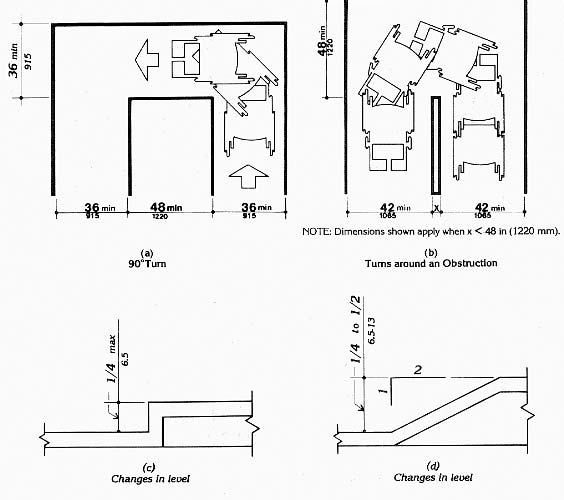
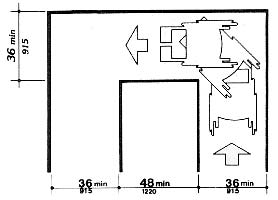
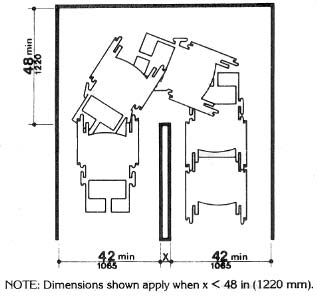
4.3.4 Passing Space
If an accessible route has less than 60 in (1525 mm) clear width, then passing spaces at least 60 in by 60 in (1525 mm by 1525 mm) shall be located at reasonable intervals not to exceed 200 ft (61 m). A T-intersection of two corridors or walks is an acceptable passing place.
4.3.5 Head Room
Accessible routes shall comply with 4.4.2.
4.3.6 Surface Textures
The surface of an accessible route shall comply with 4.5.
4.3.7 Slope
An accessible route with a running slope greater than 1:20 is a ramp and shall comply with 4.8. Nowhere shall the cross slope of an accessible route exceed 1:50.
4.3.8 Changes in Levels
Changes in levels along an accessible route shall comply with 4.5.2. If an accessible route has changes in level greater than 1/2 in (13 mm), then a curb ramp, ramp, elevator, or platform lift (as permitted in 4.1.3 and 4.1.6) shall be provided that complies with 4.7, 4.8, 4.10, or 4.11, respectively. An accessible route does not include stairs, steps, or escalators. See definition of "egress, means of" in 3.5.
4.3.9 Doors
Doors along an accessible route shall comply with 4.13.
4.3.10* Egress
Accessible routes serving any accessible space or element shall also serve as a means of egress for emergencies or connect to an accessible area of rescue assistance.
4.3.11 Areas of Rescue Assistance.
4.3.11.1 Location and Construction
An area of rescue assistance shall be one of the following:
(1) A portion of a stairway landing within a smokeproof enclosure (complying with local requirements).
(2) A portion of an exterior exit balcony located immediately adjacent to an exit stairway when the balcony complies with local requirements for exterior exit balconies. Openings to the interior of the building located within 20 feet (6 m) of the area of rescue assistance shall be protected with fire assemblies having a three-fourths hour fire protection rating.
(3) A portion of a one-hour fire-resistive corridor (complying with local requirements for fire-resistive construction and for openings) located immediately adjacent to an exit enclosure.
(4) A vestibule located immediately adjacent to an exit enclosure and constructed to the same fire-resistive standards as required for corridors and openings.
(5) A portion of a stairway landing within an exit enclosure which is vented to the exterior and is separated from the interior of the building with not less than one-hour fire-resistive doors.
(6) When approved by the appropriate local authority, an area or a room which is separated from other portions of the building by a smoke barrier. Smoke barriers shall have a fire-resistive rating of not less than one hour and shall completely enclose the area or room. Doors in the smoke barrier shall be tight-fitting smoke- and draft-control assemblies having a fire-protection rating of not less than 20 minutes and shall be self-closing or automatic closing. The area or room shall be provided with an exit directly to an exit enclosure. Where the room or area exits into an exit enclosure which is required to be of more than one-hour fire-resistive construction, the room or area shall have the same fire-resistive construction, including the same opening protection, as required for the adjacent exit enclosure.
(7) An elevator lobby when elevator shafts and adjacent lobbies are pressurized as required for smokeproof enclosures by local regulations and when complying with requirements herein for size, communication, and signage. Such pressurization system shall be activated by smoke detectors on each floor located in a manner approved by the appropriate local authority. Pressurization equipment and its duct work within the building shall be separated from other portions of the building by a minimum two-hour fire-resistive construction.
4.3.11.2 Size
Each area of rescue assistance shall provide at least two accessible areas each being not less than 30 inches by 48 inches (760 mm by 1220 mm). The area of rescue assistance shall not encroach on any required exit width. The total number of such 30-inch by 48-inch (760 mm by 1220 mm) areas per story shall be not less than one for every 200 persons of calculated occupant load served by the area of rescue assistance.
EXCEPTION: The appropriate local authority may reduce the minimum number of 30-inch by 48-inch (760 mm by 1220 mm) areas to one for each area of rescue assistance on floors where the occupant load is less than 200.
4.3.11.3* Stairway Width
Each stairway adjacent to an area of rescue assistance shall have a minimum clear width of 48 inches between handrails.
4.3.11.4* Two-way Communication
A method of two-way communication, with both visible and audible signals, shall be provided between each area of rescue assistance and the primary entry. The fire department or appropriate local authority may approve a location other than the primary entry.
4.3.11.5 Identification
Each area of rescue assistance shall be identified by a sign which states "AREA OF RESCUE ASSISTANCE" and displays the international symbol of accessibility. The sign shall be illuminated when exit sign illumination is required. Signage shall also be installed at all inaccessible exits and where otherwise necessary to clearly indicate the direction to areas of rescue assistance. In each area of rescue assistance, instructions on the use of the area under emergency conditions shall be posted adjoining the two-way communication system.

4. ACCESSIBLE ELEMENTS AND SPACES: SCOPE REQUIREMENTS AND TECHNICAL REQUIREMENTS
4.1 Minimum Requirements
4.1.1* Application
4.1.2 Accessible Sites and Exterior Facilities: New Construction
4.1.3 Accessible Buildings: New Construction
4.1.4 (Reserved)
4.1.5 Accessible Buildings: Additions
4.1.6 Accessible Buildings: Alterations
4.1.7 Accessible Buildings: Historic Preservation
4.2 Space Allowance and Reach Ranges
4.3 Accessible Route
4.4 Protruding Objects
4.5 Ground and Floor Surfaces
4.6 Parking and Passenger Loading Zones
4.7 Curb Ramps
4.8 Ramps
4.9 Stairs
4.10 Elevators
4.11 Platform Lifts (Wheelchair Lifts)
4.12 Windows
4.13 Doors
4.14 Entrances
4.15 Drinking Fountains and Water Coolers
4.16 Water Closets
4.17 Toilet Stalls
4.18 Urinals
4.19 Lavatories and Mirrors
4.20 Bathtubs
4.21 Shower Stalls
4.22 Toilet Rooms
4.23 Bathrooms, Bathing Facilities, and Shower Rooms
4.24 Sinks
4.25 Storage
4.26 Handrails, Grab Bars, and Tub and Shower Seats
4.27 Controls and Operating Mechanisms
4.28 Alarms
4.29 Detectable Warnings
4.30 Signage
4.31 Telephones
4.32 Fixed or Built-in Seating and Tables
4.33 Assembly Areas
4.34 Automated Teller Machines
4.35 Dressing and Fitting Rooms
4. ACCESSIBLE ELEMENTS AND SPACES: SCOPE AND TECHNICAL REQUIREMENTS.
(1) General. All areas of newly designed or newly constructed buildings and facilities required to be accessible by 4.1.2 and 4.1.3 and altered portions of existing buildings and facilities required to be accessible by 4.1.6 shall comply with these guidelines, 4.1 through 4.35, unless otherwise provided in this section or as modified in a special application section.
(2) Application Based on Building Use. Special application sections 5 through 10 provide additional requirements for restaurants and cafeterias, medical care facilities, business and mercantile, libraries, accessible transient lodging, and transportation facilities. When a building or facility contains more than one use covered by a special application section, each portion shall comply with the requirements for that use.
(3)* Areas Used Only by Employees as Work Areas. Areas that are used only as work areas shall be designed and constructed so that individuals with disabilities can approach, enter, and exit the areas. These guidelines do not require that any areas used only as work areas be constructed to permit maneuvering within the work area or be constructed or equipped (i.e., with racks or shelves) to be accessible.
(4) Temporary Structures. These guidelines cover temporary buildings or facilities as well as permanent facilities. Temporary buildings and facilities are not of permanent construction but are extensively used or are essential for public use for a period of time. Examples of temporary buildings or facilities covered by these guidelines include, but are not limited to: reviewing stands, temporary classrooms, bleacher areas, exhibit areas, temporary banking facilities, temporary health screening services, or temporary safe pedestrian passageways around a construction site. Structures, sites and equipment directly associated with the actual processes of construction, such as scaffolding, bridging, materials hoists, or construction trailers are not included.
(5) General Exceptions.
(a) In new construction, a person or entity is not required to meet fully the requirements of these guidelines where that person or entity can demonstrate that it is structurally impracticable to do so. Full compliance will be considered structurally impracticable only in those rare circumstances when the unique characteristics of terrain prevent the incorporation of accessibility features. If full compliance with the requirements of these guidelines is structurally impracticable, a person or entity shall comply with the requirements to the extent it is not structurally impracticable. Any portion of the building or facility which can be made accessible shall comply to the extent that it is not structurally impracticable.
(b) Accessibility is not required to (i) observation galleries used primarily for security purposes; or (ii) in non-occupiable spaces accessed only by ladders, catwalks, crawl spaces, very narrow passageways, or freight (non-passenger) elevators, and frequented only by service personnel for repair purposes; such spaces include, but are not limited to, elevator pits, elevator penthouses, piping or equipment catwalks.
4.1.2 Accessible Sites and Exterior Facilities: New Construction. An accessible site shall meet the following minimum requirements:
(1) At least one accessible route complying with 4.3 shall be provided within the boundary of the site from public transportation stops, accessible parking spaces, passenger loading zones if provided, and public streets or sidewalks, to an accessible building entrance.
(2) At least one accessible route complying with 4.3 shall connect accessible buildings, accessible facilities, accessible elements, and accessible spaces that are on the same site.
(3) All objects that protrude from surfaces or posts into circulation paths shall comply with 4.4.
(4) Ground surfaces along accessible routes and in accessible spaces shall comply with 4.5.
(5) (a) If parking spaces are provided for self-parking by employees or visitors, or both, then accessible spaces complying with 4.6 shall be provided in each such parking area in conformance with the table below. Spaces required by the table need not be provided in the particular lot. They may be provided in a different location if equivalent or greater accessibility, in terms of distance from an accessible entrance, cost and convenience is ensured.
26 to 50 51 to 75 76 to 100 101 to 150 151 to 200 201 to 300 301 to 400 401 to 500 501 to 1000 1001 and over |
2 3 4 5 6 7 8 9 2 percent of total 20, plus 1 for each 100 over 1000 |
Except as provided in (b), access aisles adjacent to accessible spaces shall be 60 in (1525 mm) wide minimum.
(b) One in every eight accessible spaces, but not less than one, shall be served by an access aisle 96 in (2440 mm) wide minimum and shall be designated "van accessible" as required by 4.6.4. The vertical clearance at such spaces shall comply with 4.6.5. All such spaces may be grouped on one level of a parking structure.
EXCEPTION: Provision of all required parking spaces in conformance with "Universal Parking Design" (see appendix A4.6.3) is permitted.
(c) If passenger loading zones are provided, then at least one passenger loading zone shall comply with 4.6.6.
(d) At facilities providing medical care and other services for persons with mobility impairments, parking spaces complying with 4.6 shall be provided in accordance with 4.1.2(5)(a) except as follows:
(i) Outpatient units and facilities: 10 percent of the total number of parking spaces provided serving each such outpatient unit or facility;
(ii) Units and facilities that specialize in treatment or services for persons with mobility impairments: 20 percent of the total number of parking spaces provided serving each such unit or facility.
(e)* Valet parking: Valet parking facilities shall provide a passenger loading zone complying with 4.6.6 located on an accessible route to the entrance of the facility. Paragraphs 5(a), 5(b), and 5(d) of this section do not apply to valet parking facilities.
(6) If toilet facilities are provided on a site, then each such public or common use toilet facility shall comply with 4.22. If bathing facilities are provided on a site, then each such public or common use bathing facility shall comply with 4.23.
For single user portable toilet or bathing units clustered at a single location, at least 5% but no less than one toilet unit or bathing unit complying with 4.22 or 4.23 shall be installed at each cluster whenever typical inaccessible units are provided.
Accessible units shall be identified by the International Symbol of Accessibility.
EXCEPTION: Portable toilet units at construction sites used exclusively by construction personnel are not required to comply with 4.1.2(6).
(7) Building Signage. Signs which designate permanent rooms and spaces shall comply with 4.30.1, 4.30.4, 4.30.5 and 4.30.6. Other signs which provide direction to, or information about, functional spaces of the building shall comply with 4.30.1, 4.30.2, 4.30.3, and 4.30.5. Elements and spaces of accessible facilities which shall be identified by the International Symbol of Accessibility and which shall comply with 4.30.7 are:
(a) Parking spaces designated as reserved for individuals with disabilities;
(b) Accessible passenger loading zones;
(c) Accessible entrances when not all are accessible (inaccessible entrances shall have directional signage to indicate the route to the nearest accessible entrance);
(d) Accessible toilet and bathing facilities when not all are accessible.
4.1.3 Accessible Buildings: New Construction. Accessible buildings and facilities shall meet the following minimum requirements:
(1) At least one accessible route complying with 4.3 shall connect accessible building or facility entrances with all accessible spaces and elements within the building or facility.
(2) All objects that overhang or protrude into circulation paths shall comply with 4.4.
(3) Ground and floor surfaces along accessible routes and in accessible rooms and spaces shall comply with 4.5.
(4) Interior and exterior stairs connecting levels that are not connected by an elevator, ramp, or other accessible means of vertical access shall comply with 4.9.
(5)* One passenger elevator complying with 4.10 shall serve each level, including mezzanines, in all multi-story buildings and facilities unless exempted below. If more than one elevator is provided, each full passenger elevator shall comply with 4.10.
EXCEPTION 1: Elevators are not required in facilities that are less than three stories or that have less than 3000 square feet per story unless the building is a shopping center, a shopping mall, or the professional office of a health care provider, or another type of facility as determined by the Attorney General. The elevator exemption set forth in this paragraph does not obviate or limit in any way the obligation to comply with the other accessibility requirements established in section 4.1.3. For example, floors above or below the accessible ground floor must meet the requirements of this section except for elevator service. If toilet or bathing facilities are provided on a level not served by an elevator, then toilet or bathing facilities must be provided on the accessible ground floor. In new construction if a building or facility is eligible for this exemption but a full passenger elevator is nonetheless planned, that elevator shall meet the requirements of 4.10 and shall serve each level in the building. A full passenger elevator that provides service from a garage to only one level of a building or facility is not required to serve other levels.
EXCEPTION 2: Elevator pits, elevator penthouses, mechanical rooms, piping or equipment catwalks are exempted from this requirement.
EXCEPTION 3: Accessible ramps complying with 4.8 may be used in lieu of an elevator.
EXCEPTION 4: Platform lifts (wheelchair lifts) complying with 4.11 of this guideline and applicable state or local codes may be used in lieu of an elevator only under the following conditions:
(a) To provide an accessible route to a performing area in an assembly occupancy.
(b) To comply with the wheelchair viewing position line-of-sight and dispersion requirements of 4.33.3.
(c) To provide access to incidental occupiable spaces and rooms which are not open to the general public and which house no more than five persons, including but not limited to equipment control rooms and projection booths.
(d) To provide access where existing site constraints or other constraints make use of a ramp or an elevator infeasible.
(6) Windows: (Reserved).
(7) Doors:
(a) At each accessible entrance to a building or facility, at least one door shall comply with 4.13.
(b) Within a building or facility, at least one door at each accessible space shall comply with 4.13.
(c) Each door that is an element of an accessible route shall comply with 4.13.
(d) Each door required by 4.3.10, Egress, shall comply with 4.13.
(8) In new construction, at a minimum, the requirements in (a) and (b) below shall be satisfied independently:
(a)(i) At least 50% of all public entrances (excluding those in (b) below) must be accessible. At least one must be a ground floor entrance. Public entrances are any entrances that are not loading or service entrances.
(ii) Accessible entrances must be provided in a number at least equivalent to the number of exits required by the applicable building/fire codes. (This paragraph does not require an increase in the total number of entrances planned for a facility.)
(iii) An accessible entrance must be provided to each tenancy in a facility (for example, individual stores in a strip shopping center).
One entrance may be considered as meeting more than one of the requirements in (a). Where feasible, accessible entrances shall be the entrances used by the majority of people visiting or working in the building.
(b)(i) In addition, if direct access is provided for pedestrians from an enclosed parking garage to the building, at least one direct entrance from the garage to the building must be accessible.
(ii) If access is provided for pedestrians from a pedestrian tunnel or elevated walkway, one entrance to the building from each tunnel or walkway must be accessible.
One entrance may be considered as meeting more than one of the requirements in (b).
Because entrances also serve as emergency exits whose proximity to all parts of buildings and facilities is essential, it is preferable that all entrances be accessible.
(c) If the only entrance to a building, or tenancy in a facility, is a service entrance, that entrance shall be accessible.
(d) Entrances which are not accessible shall have directional signage complying with 4.30.1, 4.30.2, 4.30.3, and 4.30.5, which indicates the location of the nearest accessible entrance.
(9)* In buildings or facilities, or portions of buildings or facilities, required to be accessible, accessible means of egress shall be provided in the same number as required for exits by local building/life safety regulations. Where a required exit from an occupiable level above or below a level of accessible exit discharge is not accessible, an area of rescue assistance shall be provided on each such level (in a number equal to that of inaccessible required exits). Areas of rescue assistance shall comply with 4.3.11. A horizontal exit, meeting the requirements of local building/life safety regulations, shall satisfy the requirement for an area of rescue assistance.
EXCEPTION: Areas of rescue assistance are not required in buildings or facilities having a supervised automatic sprinkler system.
(10)* Drinking Fountains:
(a) Where only one drinking fountain is provided on a floor there shall be a drinking fountain which is accessible to individuals who use wheelchairs in accordance with 4.15 and one accessible to those who have difficulty bending or stooping. (This can be accommodated by the use of a "hi-lo" fountain; by providing one fountain accessible to those who use wheelchairs and one fountain at a standard height convenient for those who have difficulty bending; by providing a fountain accessible under 4.15 and a water cooler; or by such other means as would achieve the required accessibility for each group on each floor.)
(b) Where more than one drinking fountain or water cooler is provided on a floor, 50% of those provided shall comply with 4.15 and shall be on an accessible route.
(11) Toilet Facilities: If toilet rooms are provided, then each public and common use toilet room shall comply with 4.22. Other toilet rooms provided for the use of occupants of specific spaces (i.e., a private toilet room for the occupant of a private office) shall be adaptable. If bathing rooms are provided, then each public and common use bathroom shall comply with 4.23. Accessible toilet rooms and bathing facilities shall be on an accessible route.
(12) Storage, Shelving and Display Units:
(a) If fixed or built-in storage facilities such as cabinets, shelves, closets, and drawers are provided in accessible spaces, at least one of each type provided shall contain storage space complying with 4.25. Additional storage may be provided outside of the dimensions required by 4.25.
(b) Shelves or display units allowing self-service by customers in mercantile occupancies shall be located on an accessible route complying with 4.3. Requirements for accessible reach range do not apply.
(13) Controls and operating mechanisms in accessible spaces, along accessible routes, or as parts of accessible elements (for example, light switches and dispenser controls) shall comply with 4.27.
(14) If emergency warning systems are provided, then they shall include both audible alarms and visual alarms complying with 4.28. Sleeping accommodations required to comply with 9.3 shall have an alarm system complying with 4.28. Emergency warning systems in medical care facilities may be modified to suit standard health care alarm design practice.
(15) Detectable warnings shall be provided at locations as specified in 4.29.
(16) Building Signage:
(a) Signs which designate permanent rooms and spaces shall comply with 4.30.1, 4.30.4, 4.30.5 and 4.30.6.
(b) Other signs which provide direction to or information about functional spaces of the building shall comply with 4.30.1, 4.30.2, 4.30.3, and 4.30.5.
EXCEPTION: Building directories, menus, and all other signs which are temporary are not required to comply.
(17) Public telephones:
(a) If public pay telephones, public closed circuit telephones, or other public telephones are provided, then they shall comply with 4.31.2 through 4.31.8 to the extent required by the following table:
telephone provided on each floor |
to comply with 4.31.2 through 4.31.81 |
|
|
|
|
|
|
1 Additional public telephones may be installed at any height. Unless otherwise specified, accessible telephones may be either forward or side reach telephones.
2 A bank consists of two or more adjacent public telephones, often installed as a unit.
3 EXCEPTION: For exterior installations only, if dial tone first service is available, then a side reach telephone may be installed instead of the required forward reach telephone (i.e., one telephone in proximity to each bank shall comply with 4.31).
(b)* All telephones required to be accessible and complying with 4.31.2 through 4.31.8 shall be equipped with a volume control. In addition, 25 percent, but never less than one, of all other public telephones provided shall be equipped with a volume control and shall be dispersed among all types of public telephones, including closed circuit telephones, throughout the building or facility. Signage complying with applicable provisions of 4.30.7 shall be provided.
(c) The following shall be provided in accordance with 4.31.9:
(i) if a total number of four or more public pay telephones (including both interior and exterior phones) is provided at a site, and at least one is in an interior location, then at least one interior public text telephone shall be provided.
(ii) if an interior public pay telephone is provided in a stadium or arena, in a convention center, in a hotel with a convention center, or in a covered mall, at least one interior public text telephone shall be provided in the facility.
(iii) if a public pay telephone is located in or adjacent to a hospital emergency room, hospital recovery room, or hospital waiting room, one public text telephone shall be provided at each such location.
(d) Where a bank of telephones in the interior of a building consists of three or more public pay telephones, at least one public pay telephone in each such bank shall be equipped with a shelf and outlet in compliance with 4.31.9(2).
(18) If fixed or built-in seating or tables (including, but not limited to, study carrels and student laboratory stations), are provided in accessible public or common use areas, at least five percent (5%), but not less than one, of the fixed or built-in seating areas or tables shall comply with 4.32. An accessible route shall lead to and through such fixed or built-in seating areas, or tables.
(19)* Assembly areas:
(a) In places of assembly with fixed seating accessible wheelchair locations shall comply with 4.33.2, 4.33.3, and 4.33.4 and shall be provided consistent with the following table:
in Assembly Areas |
Wheelchair Locations |
26 to 50 51 to 300 301 to 500 |
2 4 6 |
seating capacity increase of 100 |
In addition, one percent, but not less than one, of all fixed seats shall be aisle seats with no armrests on the aisle side, or removable or folding armrests on the aisle side. Each such seat shall be identified by a sign or marker. Signage notifying patrons of the availability of such seats shall be posted at the ticket office. Aisle seats are not required to comply with 4.33.4.
(b) This paragraph applies to assembly areas where audible communications are integral to the use of the space (e.g., concert and lecture halls, playhouses and movie theaters, meeting rooms, etc.). Such assembly areas, if (1) they accommodate at least 50 persons, or if they have audio-amplification systems, and (2) they have fixed seating, shall have a permanently installed assistive listening system complying with 4.33. For other assembly areas, a permanently installed assistive listening system, or an adequate number of electrical outlets or other supplementary wiring necessary to support a portable assistive listening system shall be provided. The minimum number of receivers to be provided shall be equal to 4 percent of the total number of seats, but in no case less than two. Signage complying with applicable provisions of 4.30 shall be installed to notify patrons of the availability of a listening system.
(20) Where automated teller machines (ATMs) are provided, each ATM shall comply with the requirements of 4.34 except where two or more are provided at a location, then only one must comply.
EXCEPTION: Drive-up-only automated teller machines are not required to comply with 4.27.2, 4.27.3 and 4.34.3.
(21) Where dressing and fitting rooms are provided for use by the general public, patients, customers or employees, 5 percent, but never less than one, of dressing rooms for each type of use in each cluster of dressing rooms shall be accessible and shall comply with 4.35.
Examples of types of dressing rooms are those serving different genders or distinct and different functions as in different treatment or examination facilities.
4.1.4 (Reserved).
4.1.5 Accessible Buildings: Additions
Each addition to an existing building or facility shall be regarded as an alteration. Each space or element added to the existing building or facility shall comply with the applicable provisions of 4.1.1 to 4.1.3, Minimum Requirements (for New Construction) and the applicable technical specifications of 4.2 through 4.35 and sections 5 through 10. Each addition that affects or could affect the usability of an area containing a primary function shall comply with 4.1.6(2).
4.1.6 Accessible Buildings: Alterations.
(1) General. Alterations to existing buildings and facilities shall comply with the following:
(a) No alteration shall be undertaken which decreases or has the effect of decreasing accessibility or usability of a building or facility below the requirements for new construction at the time of alteration.
(b) If existing elements, spaces, or common areas are altered, then each such altered element, space, feature, or area shall comply with the applicable provisions of 4.1.1 to 4.1.3 Minimum Requirements (for New Construction). If the applicable provision for new construction requires that an element, space, or common area be on an accessible route, the altered element, space, or common area is not required to be on an accessible route except as provided in 4.1.6(2) (Alterations to an Area Containing a Primary Function.)
(c) If alterations of single elements, when considered together, amount to an alteration of a room or space in a building or facility, the entire space shall be made accessible.
(d) No alteration of an existing element, space, or area of a building or facility shall impose a requirement for greater accessibility than that which would be required for new construction. For example, if the elevators and stairs in a building are being altered and the elevators are, in turn, being made accessible, then no accessibility modifications are required to the stairs connecting levels connected by the elevator. If stair modifications to correct unsafe conditions are required by other codes, the modifications shall be done in compliance with these guidelines unless technically infeasible.
(e) At least one interior public text telephone complying with 4.31.9 shall be provided if:
(i) alterations to existing buildings or facilities with less than four exterior or interior public pay telephones would increase the total number to four or more telephones with at least one in an interior location; or
(ii) alterations to one or more exterior or interior public pay telephones occur in an existing building or facility with four or more public telephones with at least one in an interior location.
(f) If an escalator or stair is planned or installed where none existed previously and major structural modifications are necessary for such installation, then a means of accessible vertical access shall be provided that complies with the applicable provisions of 4.7, 4.8, 4.10, or 4.11.
(g) In alterations, the requirements of 4.1.3(9), 4.3.10 and 4.3.11 do not apply.
(h)* Entrances: If a planned alteration entails alterations to an entrance, and the building has an accessible entrance, the entrance being altered is not required to comply with 4.1.3(8), except to the extent required by 4.1.6(2). If a particular entrance is not made accessible, appropriate accessible signage indicating the location of the nearest accessible entrance(s) shall be installed at or near the inaccessible entrance, such that a person with disabilities will not be required to retrace the approach route from the inaccessible entrance.
(i) If the alteration work is limited solely to the electrical, mechanical, or plumbing system, or to hazardous material abatement, or automatic sprinkler retrofitting, and does not involve the alteration of any elements or spaces required to be accessible under these guidelines, then 4.1.6(2) does not apply.
(j) EXCEPTION: In alteration work, if compliance with 4.1.6 is technically infeasible, the alteration shall provide accessibility to the maximum extent feasible. Any elements or features of the building or facility that are being altered and can be made accessible shall be made accessible within the scope of the alteration.
Technically Infeasible. Means, with respect to an alteration of a building or a facility, that it has little likelihood of being accomplished because existing structural conditions would require removing or altering a load-bearing member which is an essential part of the structural frame; or because other existing physical or site constraints prohibit modification or addition of elements, spaces, or features which are in full and strict compliance with the minimum requirements for new construction and which are necessary to provide accessibility.
(k) EXCEPTION:
(i) These guidelines do not require the installation of an elevator in an altered facility that is less than three stories or has less than 3,000 square feet per story unless the building is a shopping center, a shopping mall, the professional office of a health care provider, or another type of facility as determined by the Attorney General.
(ii) The exemption provided in paragraph (i) does not obviate or limit in any way the obligation to comply with the other accessibility requirements established in these guidelines. For example, alterations to floors above or below the ground floor must be accessible regardless of whether the altered facility has an elevator. If a facility subject to the elevator exemption set forth in paragraph (i) nonetheless has a full passenger elevator, that elevator shall meet, to the maximum extent feasible, the accessibility requirements of these guidelines.
(2) Alterations to an Area Containing a Primary Function: In addition to the requirements of 4.1.6(1), an alteration that affects or could affect the usability of or access to an area containing a primary function shall be made so as to ensure that, to the maximum extent feasible, the path of travel to the altered area and the restrooms, telephones, and drinking fountains serving the altered area, are readily accessible to and usable by individuals with disabilities, unless such alterations are disproportionate to the overall alterations in terms of cost and scope (as determined under criteria established by the Attorney General).
(3) Special Technical Provisions for Alterations to Existing Buildings and Facilities:
(a) Ramps: Curb ramps and interior or exterior ramps to be constructed on sites or in existing buildings or facilities where space limitations prohibit the use of a 1:12 slope or less may have slopes and rises as follows:
(i) A slope between 1:10 and 1:12 is allowed for a maximum rise of 6 inches.
(ii) A slope between 1:8 and 1:10 is allowed for a maximum rise of 3 inches. A slope steeper than 1:8 is not allowed.
(b) Stairs: Full extension of handrails at stairs shall not be required in alterations where such extensions would be hazardous or impossible due to plan configuration.
(c) Elevators:
(i) If safety door edges are provided in existing automatic elevators, automatic door reopening devices may be omitted (see 4.10.6).
(ii) Where existing shaft configuration or technical infeasibility prohibits strict compliance with 4.10.9, the minimum car plan dimensions may be reduced by the minimum amount necessary, but in no case shall the inside car area be smaller than 48 in by 48 in.
(iii) Equivalent facilitation may be provided with an elevator car of different dimensions when usability can be demonstrated and when all other elements required to be accessible comply with the applicable provisions of 4.10. For example, an elevator of 47 in by 69 in (1195 mm by 1755 mm) with a door opening on the narrow dimension, could accommodate the standard wheelchair clearances shown in Figure 4.
(d) Doors:
(i) Where it is technically infeasible to comply with clear opening width requirements of 4.13.5, a projection of 5/8 in maximum will be permitted for the latch side stop.
(ii) If existing thresholds are 3/4 in high or less, and have (or are modified to have) a beveled edge on each side, they may remain.
(e) Toilet Rooms:
(i) Where it is technically infeasible to comply with 4.22 or 4.23, the installation of at least one unisex toilet/bathroom per floor, located in the same area as existing toilet facilities, will be permitted in lieu of modifying existing toilet facilities to be accessible. Each unisex toilet room shall contain one water closet complying with 4.16 and one lavatory complying with 4.19, and the door shall have a privacy latch.
(ii) Where it is technically infeasible to install a required standard stall (Fig. 30(a)), or where other codes prohibit reduction of the fixture count (i.e., removal of a water closet in order to create a double-wide stall), either alternate stall (Fig.30(b)) may be provided in lieu of the standard stall.
(iii) When existing toilet or bathing facilities are being altered and are not made accessible, signage complying with 4.30.1, 4.30.2, 4.30.3, 4.30.5, and 4.30.7 shall be provided indicating the location of the nearest accessible toilet or bathing facility within the facility.
(f) Assembly Areas:
(i) Where it is technically infeasible to disperse accessible seating throughout an altered assembly area, accessible seating areas may be clustered. Each accessible seating area shall have provisions for companion seating and shall be located on an accessible route that also serves as a means of emergency egress.
(ii) Where it is technically infeasible to alter all performing areas to be on an accessible route, at least one of each type of performing area shall be made accessible.
(g) Platform Lifts (Wheelchair Lifts): In alterations, platform lifts (wheelchair lifts) complying with 4.11 and applicable state or local codes may be used as part of an accessible route. The use of lifts is not limited to the four conditions in exception 4 of 4.1.3(5)
(h) Dressing Rooms: In alterations where technical infeasibility can be demonstrated, one dressing room for each sex on each level shall be made accessible. Where only unisex dressing rooms are provided, accessible unisex dressing rooms may be used to fulfill this requirement.
4.1.7 Accessible Buildings: Historic Preservation.

(1) Applicability:
(a) General Rule. Alterations to a qualified historic building or facility shall comply with 4.1.6 Accessible Buildings: Alterations, the applicable technical specifications of 4.2 through 4.35 and the applicable special application sections 5 through 10 unless it is determined in accordance with the procedures in 4.1.7(2) that compliance with the requirements for accessible routes (exterior and interior), ramps, entrances, or toilets would threaten or destroy the historic significance of the building or facility in which case the alternative requirements in 4.1.7(3) may be used for the feature.
EXCEPTION: (Reserved).
(b) Definition. A qualified historic building or facility is a building or facility that is:
(i) Listed in or eligible for listing in the National Register of Historic Places; or
(ii) Designated as historic under an appropriate State or local law.
(2) Procedures:
(a) Alterations to Qualified Historic Buildings and Facilities Subject to Section 106 of the National Historic Preservation Act:
(i) Section 106 Process. Section 106 of the National Historic Preservation Act (16 U.S.C. 470 f) requires that a Federal agency with jurisdiction over a Federal, federally assisted, or federally licensed undertaking consider the effects of the agency's undertaking on buildings and facilities listed in or eligible for listing in the National Register of Historic Places and give the Advisory Council on Historic Preservation a reasonable opportunity to comment on the undertaking prior to approval of the undertaking.
(ii) ADA Application. Where alterations are undertaken to a qualified historic building or facility that is subject to section 106 of the National Historic Preservation Act, the Federal agency with jurisdiction over the undertaking shall follow the section 106 process. If the State Historic Preservation Officer or Advisory Council on Historic Preservation agrees that compliance with the requirements for accessible routes (exterior and interior), ramps, entrances, or toilets would threaten or destroy the historic significance of the building or facility, the alternative requirements in 4.1.7(3) may be used for the feature.
(b) Alterations to Qualified Historic Buildings and Facilities Not Subject to Section 106 of the National Historic Preservation Act. Where alterations are undertaken to a qualified historic building or facility that is not subject to section 106 of the National Historic Preservation Act, if the entity undertaking the alterations believes that compliance with the requirements for accessible routes (exterior and interior), ramps, entrances, or toilets would threaten or destroy the historic significance of the building or facility and that the alternative requirements in 4.1.7(3) should be used for the feature, the entity should consult with the State Historic Preservation Officer. If the State Historic Preservation Officer agrees that compliance with the accessibility requirements for accessible routes (exterior and interior), ramps, entrances or toilets would threaten or destroy the historical significance of the building or facility, the alternative requirements in 4.1.7(3) may be used.
(c) Consultation With Interested Persons. Interested persons should be invited to participate in the consultation process, including State or local accessibility officials, individuals with disabilities, and organizations representing individuals with disabilities.
(d) Certified Local Government Historic Preservation
Programs. Where the State Historic Preservation Officer has delegated the consultation responsibility for purposes of this section to a local government historic preservation program that has been certified in accordance with section 101(c) of the National Historic Preservation Act of 1966 (16 U.S.C. 470a (c)) and implementing regulations (36 CFR 61.5), the responsibility may be carried out by the appropriate local government body or official.
(3) Historic Preservation: Minimum Requirements:
(a) At least one accessible route complying with 4.3 from a site access point to an accessible entrance shall be provided.
EXCEPTION: A ramp with a slope no greater than 1:6 for a run not to exceed 2 ft (610 mm) may be used as part of an accessible route to an entrance.
(b) At least one accessible entrance complying with 4.14 which is used by the public shall be provided.
EXCEPTION: If it is determined that no entrance used by the public can comply with 4.14, then access at any entrance not used by the general public but open (unlocked) with directional signage at the primary entrance may be used. The accessible entrance shall also have a notification system. Where security is a problem, remote monitoring may be used.
(c) If toilets are provided, then at least one toilet facility complying with 4.22 and 4.1.6 shall be provided along an accessible route that complies with 4.3. Such toilet facility may be unisex in design.
(d) Accessible routes from an accessible entrance to all publicly used spaces on at least the level of the accessible entrance shall be provided. Access shall be provided to all levels of a building or facility in compliance with 4.1 whenever practical.
(e) Displays and written information, documents, etc., should be located where they can be seen by a seated person. Exhibits and signage displayed horizontally (e.g., open books), should be no higher than 44 in (1120 mm) above the floor surface.
NOTE: The technical provisions of sections 4.2 through 4.35 are the same as those of the American National Standard Institute's document A117.1-1980, except as noted in the text.
4.2 Space Allowance and Reach Ranges.
4.2.1* Wheelchair Passage Width
The minimum clear width for single wheelchair passage shall be 32 in (815 mm) at a point and 36 in (915 mm) continuously.
 |

|
4.2.2 Width for Wheelchair Passing
The minimum width for two wheelchairs to pass is 60 in (1525 mm).

4.2.3* Wheelchair Turning Space
The space required for a wheelchair to make a 180-degree turn is a clear space of 60 in (1525 mm) diameter or a T-shaped space.

4.2.4* Clear Floor or Ground Space for Wheelchairs.
4.2.4.1 Size and Approach
The minimum clear floor or ground space required to accommodate a single, stationary wheelchair and occupant is 30 in by 48 in (760 mm by 1220 mm).


The minimum clear floor or ground space for wheelchairs may be positioned for forward or parallel approach to an object.


Clear floor or ground space for wheelchairs may be part of the knee space required under some objects.
4.2.4.2 Relationship of Maneuvering Clearance to Wheelchair Spaces
One full unobstructed side of the clear floor or ground space for a wheelchair shall adjoin or overlap an accessible route or adjoin another wheelchair clear floor space. If a clear floor space is located in an alcove or otherwise confined on all or part of three sides, additional maneuvering clearances shall be provided as shown in pictures here-under.


4.2.4.3 Surfaces for Wheelchair Spaces
Clear floor or ground spaces for wheelchairs shall comply with 4.5.
4.2.5* Forward Reach
If the clear floor space only allows forward approach to an object, the maximum high forward reach allowed shall be 48 in (1220 mm).


The minimum low forward reach is 15 in (380 mm). If the high forward reach is over an obstruction, reach and clearances shall be as shown in here-under.

4.2.6* Side Reach
If the clear floor space allows parallel approach by a person in a wheelchair, the maximum high side reach allowed shall be 54 in (1370 mm) and the low side reach shall be no less than 9 in (230 mm) above the floor.


If the side reach is over an obstruction, the reach and clearances shall be see here-under.